The purpose of this project is to design and mass-produce kits for a floating tiny house that can sail. It combines high-tech modeling and fabrication and low-tech assembly that can be carried out DIY-style on a riverbank or a beach. This boat is a four-bedroom with a kitchen, a bathroom/sauna, a dining room and a living room. The deck is big enough to throw dance parties. It can be used as a river boat, a canal boat or even a beach house. It's rugged and stable enough to take out on the ocean.

Wednesday, January 21, 2015

LOA = LOD

This decodes to “Length overall is same as length on deck.” You see, boats spend a lot of time at marinas, and marinas charge by the foot, based on LOA. If your boat has a bowsprit sticking forward from the bow or dinghy davits hanging off the transom, then you are paying lots of money to rent space for a few sticks which don't do you any good at all while your boat is sitting there at the marina. I know some boats with huge, glorious bowsprits, complete with so-called “dolphin strikers,” protruding majestically (homoerotically?) from their bows. These boats have sat at the same marina for years, perhaps venturing out into the harbor for a day or so once or twice a season. I shudder to think what those silly sticks have cost their owners in slip fees.

There is no reason for a bowsprit on a Junk-rigged boat, making that decision easy. As far as the dinghy davits, a better solution is dinghy forks. These are sticks that hide in deep sockets built into the hull and slide out when they are needed. To store a dinghy, the dink is lifted out of the water on a halyard, plopped down onto the forks, and flipped over, so that it sits on two sticks bottom-up. A single line can then be used to secure it to the sticks.

This approach works very well with hard dinks, and less well with so-called “deflatables.” Some people optimistically call them “inflatables”; however, they are never guaranteed to inflate and always guaranteed to deflate, so the term “deflatable” fits better. Deflatables cost lots of money, don't last very long and row like pigs. On the other hand, it takes just a couple of days and a few tools to fashion a good hard dink out of a couple of sheets of plywood, some fiberglass and epoxy and some paint, and the result is surprisingly durable and effective.

There is room for three sets of dinghy forks: off the transom, and one each to port and starboard, for a total of three dinks that can be stored while at anchor. When underway, only the transom forks can be used because the others would hit the water when the boat is heeled over. When the sea is rough, dinks should be secured on deck, and having a large and level flush deck makes this easy. If they are nesting dinks, than this saves even more space. Dinghy forks can also be used to fashion swimming or fishing platforms. Canvas can be stretched over them to collect rainwater.

That is a lot of functionality for the cost of a few sticks!

Tuesday, January 20, 2015

The masts

About the most cost-effective and quick way of making a mast is to use a tapered aluminum flagpole. That is what I had on HOGFISH, and it worked just fine. There the mainmast was stepped in a tabernacle, and had 4 lower shrouds (fore and aft), 2 uppers (aft only) with no spreaders, a genoa stay which went to the end of the bowsprit and a staysl stay. Taking down the mainmast, and putting it back up, was always a bit of an adventure. Getting the mast up or down was pretty much the easy part; it was rigging and unrigging the gin pole, and detaching, coiling, reattaching and tuning the standing rigging that took all the time. Plus all that coiled wire rope cluttered up the deck when the mast was down.

On QUIDNON, I intend to go with unstayed masts. The arrangement I have thought up is as follows. The tabernacle of each mast consists of a galvanized steel pipe with a bracket made of steel plate welded to the top of it. The bottom of the pipe rests in a cup cast into to the concrete bottom, in which it turns freely if you twist it hard enough. The cup has a drainage path into the bilge, to shed any water that finds itself into the pipe. After fabrication, the tabernacles are slag-blasted and hot-dip galvanized.

At the deck, the pipe goes through a precise, snug-fitting hole in a very substantial hardwood block (unvarnished teak) which is bolted through the deck and also tied into a frame made up of deck beams, knees and ribs. The pipe has a ring welded to it that rests flush against the bottom of the hardwood block, preventing the masts from falling out in case of a capsize. The ring is cupped, and there is a couple of small holes drilled through the pipe level with the upper surface of the ring, so that any water that finds its way there does not drip into the cabin but goes inside the pipe and eventually finds its way into the bilge.

The top end of the pipe has a three-sided bracket welded to it made of steel plate. The top of the bracket forms a slot which accepts the heel of the mast, allowing it to pivot.

The bottom end of the mast is fitted with a plug milled and lathed out of a block of aluminum. The part of the plug that fits inside the mast is lathed to the correct diameter and taper for a very precise fit. The mast and the plug are mated for life by driving the plug into the mast with a sledge. There is a mechanical screw holding the two together, but it's mostly there to stop people from asking questions.

The bottom of the plug (the heel) is square in cross-section, and precisely fits the slot in the bracket with which it mates with just enough room for two large fiberglass washers inserted where galvanized steel and aluminum meet whose job is to prevent them from galling together. It has holes drilled into it for two bolts. These two bolts can properly be called "Jesus bolts," because, as with the "Jesus nut" that holds helicopter rotors together, the failure of either one of them would tend to interrupt one's voyage in a serious way. These will be one-inch diameter stainless steel bolts, and keeping them tight, clean and oiled is a key bit preventive maintenance. The mast heel also has a hole drilled partway into it at a 45º angle that accepts a gin pole, which is a 1-inch diameter solid aluminum rod that has a sheave on one end. There is a short pendant threaded through the sheave. The pendant has a thimble on one end and a snap shackle on the other. Lastly, there are two rings welded to the tabernacle pipe, one right below the mast, and another right above the deck. The boat will carry two gin poles, for a reason that will become clear in a moment.

The masts are erected in 12 easy steps:

1. The mast is maneuvered so that the square end of its plug sits in the slot in the tabernacle.
2. The top "Jesus bolt" is inserted and assembled with washer and nut, but not tightened.
3. The bottom "Jesus bolt" is dropped into its hole in the plug from the front but the nut is left off.
4. The gin pole is inserted into the plug, and the 4-part halyard block is attached to thimbled end of the gin pole pendant.
5. The end of the halyard is sent through a snatch block hooked onto the ring on the tabernacle right below the mast, then all the way back to the anchor winch in the pilot house.
6. The snap shackle at the other end of the gin pole pendant is attached to the ring on the tabernacle pipe right above the deck.
7. The halyard is hauled in using the anchor winch until the mast flops forward in its bracket, then cleated off. (QUIDNON's masts have forward rake.)
8. Washer and nut are threaded onto the second, lower "Jesus bolt" at this point, so that the mast doesn't come crashing down if a big wave hits once the halyard is released.
9. The halyard is released and detached from the gin pole pendant.
10. The gin pole is pulled out of the plug.
11. The "Jesus bolts" are tightened using two large box-end wrenches.
12. The happy single-hander, who has just single-handedly raised a mast without any fuss at all, does a little victory dance.

The procedure for lowering the masts is basically the reverse of the procedure for raising them, with just one additional step: once the halyard is attached and tensioned and the nut from the bottom "Jesus bolt" is removed, the tip of the mast has to be pulled aft using one of the topping lifts. Then the halyard can be paid out slowly, and the mast will come down.

Once both masts are down, the two gin poles are inserted in the holes through which the top "Jesus bolts" go. The masts rest on the gin poles, along with the sails, and are lashed down to them in a single tidy bundle. (You didn't expect the gin poles to serve just one function, now, did you?) The masts do not overhang either the bow or the stern of the boat, and do not incur any penalties in the form of increased slip fees (which are based on LOA—length overall) when QUIDNON is being used as a canal boat, with the masts down.

A mast wiring bundle comes out of a hole in each mast right above the plug, threaded through a length of hose. The hose screws onto male hose fittings on the mast and on the tabernacle. From there, the wiring runs down through the tabernacle pipe, out its bottom, and through a wiring chase cast into the bottom, then up through conduits that lead to the switch panel and the instrument panel. For lightning protection, the mast is electrically bonded to the tabernacle, and the tabernacle to the copper cladding on the bottom of the boat.

In calm conditions this operation can be managed by one person, but if there is a big sea running some extra hands may be needed to keep the mast from twisting around as it's going up. This can be done by running the topping lifts to the stern and keeping some tension on them. The other option is to simply let it twist as it likes, because once it's up it can be rotated to the desired orientation by putting one's heel against the gin pole. It's a good idea to put up the foremast before the mainmast, to eliminate the chance of the foremast banging into the mainmast and denting it as it comes up. For the same reason, when taking the masts down, the mainmast should come down first.

I would think that with this system a well-trained crew could drop sails and the masts in about 15-20 minutes, start to finish, and to put them up and get ready to sail in the same amount of time.

Monday, January 19, 2015

Creature Comforts

Sailboats, even relatively spacious boats the size of QUIDNON, are often somewhat lacking in creature comforts. Since they are partially submerged, the cabins are susceptible to becoming damp, and to growing mold. The relatively small airspace within the cabin allows smells to easily spread throughout. If somebody is cooking a stew, the entire boat smells like stew; if then eating it gives someone indigestion, the entire boat smells like indigestion. Many boats are equipped with Dorade vents, which, when pointed into the wind, direct some of it into the cabin. The amount of ventilation they produce is either too much or not enough. They also interfere with keeping the cabin warm because they allow the heat to escape.

In colder climates, condensation from breathing and cooking with propane (which makes water vapor) tends to condense on walls, and especially on portlights and hatches, and cause cold drips. Few things are less pleasant than trying to sleep under a hatch that periodically drips icy water on your head.

Sailboat cabins also tend to be rather dark. This is because it is very hard to provide enough hatches and portlights to properly illuminate the interior. Also, most older boats were built in an era where light fixtures were expensive and inefficient, and only provided little reading lamps here and there instead of lighting up the entire cabin.

Lastly, hatches and portlights often present a hazard. I am yet to see a commercially sold portlight that can't be easily smashed in by a big breaking wave, or a hatch that can't be stove in by a flailing broken spar. They are usually held closed by two little plastic tabs that break off quite easily. There are some old bronze portlights that are secured using a substantial toggle, but these are expensive.

Add to this the fact that the various commercially available bits and pieces—portlights, hatches, Dorade vents and so on—cost real money, which is nowhere to be found in QUIDNON's tight budget. Therefore, the approach I plan to take is quite different.

Illumination


Day
The cost-effective approach to lighting up the cabin is to have lots and lots of deadlights. Right below the gunwale will be a fat strip of plywood, made up of 3 ¾-inch thicknesses of plywood screwed together. It has to be thick because it is structural. Into this thickness of plywood are milled round holes, each only about 8 inches in diameter, but since there are 32 of them evenly distributed all around, that adds up to 11 square feet. On the outside, the entire strip is covered over with ¼-inch Lexan, which is caulked and screwed to the plywood. This combination is quite indestructible, and very cheap to make.

Night
When it's dark outside, the cabin will be lit up using strips of LED lights mounted above and below the row of deadlights all around the cabin. This will produce a nice, even glow throughout. There will also be reading and cooking LED lamps installed in various places. The efficiency and low cost and reliability of LED lights is such that it is very hard to burn too much electricity, or money, by installing lots of them.

Since the cabin is quite wide, the deadlights and the LED strips will not be effective in illuminating the center of the cabin. For this, a large hatch will be built into the deck, right in front of the mainmast. It will be constructed as an upside-down box measuring 6 ½ by 2 ½ feet and about a foot high. This box will be secured upside-down over a foot-high plywood dam that will surround the opening in the deck. Two foam rubber gaskets, one around the inner edge of the box, the other around the outside of the dam, will prevent ingress of water even when waves run across the deck. The hatch will be double-glazed with one ½-inch Lexan reinforced with some ribs made of aluminum channel, and another, much thinner layer of Lexan below an air gap, to prevent condensation.

To provide ventilation, the hatch will be propped partially open in some direction, so as to serve as a wind scoop. While at sea, the hatch will be secured using wing nuts and toggles made of threaded rod. The hatch will also be used to load and unload provisions and cargo and to move major pieces of equipment (range, stove, water heater, refrigerator, etc.)

Ventilation and exhaust

In keeping with the strategy of making each element perform as many functions as possible in order to minimize cost, the boom gallows will be hollow, constructed out of plywood box sections, in order to perform all of the following:

1. Prop up the back end of the foresail when it is lowered and secured.

2. Serve as an air collector, using the force of the wind (from whichever direction) to send air down below.

3. House exhaust plenums for the stove flue, the fume hood in the galley, and the so-called “stink pipe” from the holding tank.

4. Provide a mounting point for a radome (since there is no other place to mount one) and also house an AIS receiver, a WIFI repeater and whatever other electronics that need to be installed above deck.

5. Provide a mounting point for the foresail sheet blocks.

6. Incorporate hooks for hanging a hammock directly under it.

7. In the middle of the underside, incorporate a hook for attaching a hoist for lifting objects in and out through the deck hatch.

8. Provide attachment points for a tarp that provides a roof over most of the deck.

Insulation and condensation

Most sailboats are downright unpleasant to live on during the winter. Not only are they cramped to the point of causing cabin fever, but they tend to be poorly insulated, and therefore very expensive to heat. Not only that, but heating the air inside the cabin fails to produce a comfortable environment because the surrounding hull, which is in direct contact with the cold water and the cold air, remains cold. Some boats cabins are penetrated by a keel-stepped aluminum mast, which serves as a large heat sink, absorbing warmth and conducting it to the outside, because the builders failed to insulate it.

Directly insulating the sides is effective, but causes a secondary problem. Condensation does have to form somewhere, and if insulation is applied directly to the inside of the hull, then condensation will form between the hull and the insulation (it is quite impossible to make it airtight) become trapped there and cause mildew.

It also seems that no boat designer has addressed the problem of insulating the cabin sole, which is invariably very cold. Spending all winter with cold feet is far less than pleasant. One winter I resorted to covering the cabin sole with insulation where I normally sit or stand. This fixed the problem, more or less. On QUIDNON, the cabin sole will be backed with radiant barrier and foam insulation.

On QUIDNON, I plan to address these problems as follows. The inside of the hull will not be insulated at all. Instead, there will be an air gap between the hull and the walls of the cabin, which will be made of an additional layer of plywood mounted over fir ribs. It is the outside of the inner walls that will be insulated with ¾-inch pink foam insulation and radiant barrier. The function of the air gap will be to thermally isolate the cabin from the hull, and to allow condensation to form freely on the hull, drain to the bilge, and be pumped overboard by the bilge pump. Condensation is actually important, because it eliminates moisture from the air. To this end, the 32 deadlights all around the cabin will not be double-glazed. Instead, each one will be provided with a small recess at its bottom, where condensation will be allowed to pool, and a trickle path down to the bilge. (I got this bright idea from Sven Yrvind.)

A secondary function of the air gap between the hull and the cabin will be to provide passive solar heating and cooling. The topsides will be painted black, to absorb as much solar radiation as possible, and pass it through the fiberglass and the plywood to the air gap, warming the air. Warm air rises, creating a flow. Baffles and ducts will direct this warm airflow for either heating or cooling. To heat, the air flow will be directed into the cabin while fresh air will be supplied from the vents in the boom gallows. To cool, the air flow will be directed out through the exhaust plenums built into the boom gallows, pulling cool air into the cabin from the relatively cooler bilge or from the engine well where it's always dark and, when the engine isn't running, relatively cool.

The underside of the deck will be insulated directly, with ¾-inch pink foam, radiant barrier top and bottom, and a soft liner (for the hard heads of some extra-tall people). The reason for the two layers of radiant barrier is this: the outer, top layer will reflect heat from the sun, whereas the inner, bottom layer will reflect heat back into the cabin. Here, there is no room for an air gap, no way to arrange for drainage of condensation, plus, if the boat is heated at all, then warm air tends to accumulate right under the deck, making it warmer than the dew point. Here, the approach will be to create an airtight seal between the insulation and the underside of the deck, with expanding foam sprayed into all the gaps. Although in general terms like “airtight” and “watertight” never entirely apply to boats, in this case this strategy seems to work: this is what I did on HOGFISH, and, unlike the sides, the cabintop never had any issues with mold.

Below deck, the mast tabernacles will be insulated with a layer of radiant barrier and a layer of fabric to prevent them from acting like heat sinks.

Heat

The choices for keeping a boat warm are limited to diesel (not a good choice for QUIDNON, which will not use diesel), propane (a good, cost-effective choice) and, when the boat has access to shore power, electric space heaters (convenient but very expensive and not particularly safe). Another choice, which some marinas unfortunately forbid, is solid fuel (wood and charcoal). Solid fuel is the least expensive option, and in some ways the most pleasant, because the heat it produces is very dry.

QUIDNON will have a solid fuel stove installed in the shower/sauna compartment, with propane as back-up wherever solid fuel happens to be outlawed. A circulator fan will be used to move the hot air from the shower compartment to the rest of the boat, or to exhaust it to the outside (while someone is showering), or to leave it in place (for using the compartment as a sauna/steam room). To accommodate all these uses, the shower stall will be constructed with a moisture barrier and paneled with pine boards.

Hot water

An 11-gallon water heater is a good choice for when shore power is available, but how does one shower when living at anchor or while under way? A good, cheap choice turns out to be a propane-fired tankless water heater. These are designed to be used for camp showers outdoors, but they can be used indoors provided they are installed with safety in mind and provided the exhaust they produce is vented outside. I believe there will be enough room in the heads to install one of these as well.
Sunday, January 18, 2015

The Sea-gypsy start-up manual

[This is a guest post from Ray, who sailed off from San Francisco some years ago and has been living as a sea gypsy ever since. Sea gypsies have a lot going for them: relative self-sufficiency and self-reliance, camaraderie, competence, mobility and plenty of free, open habitat where they can roam freely. Part of the impetus behind designing QUIDNON is to provide a cheap and viable alternative to the rather overpriced and inadequate offerings of the commercial recreational sailboat market, making the sea gypsy lifestyle accessible to more people.]

In my last essay, I proposed an unusual response to the possibility of global societal collapse that previously has not been suggested.  My core message was summed up in these 30 words:

“I believe that if there is a near extinction catastrophe, a sea gypsy tribe has the best chance of both surviving and replenishing the human population in the wisest manner.”

For those of you who may not have read that article, I encourage you to do so before continuing with this one.  THAT piece provides the “why to” background information for my belief that economic, energy and ecological disasters are very possible in our near future.  It then suggests that various sea gypsy tribes scattered about the planet provide an excellent survival and re-seeding option.  THIS article provides the basic “how to” information for anyone who was inspired by my message, and would like to join our movement.  My sense is that there are three potential types of candidates.  I refer to them as Seekers, Converts and Recruits.

Saturday, January 17, 2015

Small boat voyaging for the accident-prone


[On weekends this blog takes a break from designing QUIDNON. Here is a recycled article of mine from some time ago.]

The world is full of stories of success, mostly because successful people like to tell of their victories rather than expound on their defeats. This is self-serving of them and a loss to the rest of us, because we only learn from mistakes. The best kind are small, non-fatal mistakes; these are also the most common. Disastrous, fatal errors are rarely the first ones to be made, because it usually takes a compounding of errors to give rise to a fatal situation. And so here is a little object study of a series of small errors, the problems they caused, and the solutions they necessitated.

Friday, January 16, 2015

The Cabin

The cabin layout is designed to work with lots of people milling about. A representative scenario is as follows: a bunch of people have shown up and want to party; they have brought children who have to be put to bed at some point. Some people want mingle, others want to sit quietly in a corner and chat. Some people are hungry, and there is food being prepared. Some people don't mind at all that the boat has a sauna/steam room, and wish to avail themselves of it. Some people want to sleep; some other people want to have sex. There is a pole-dancer in the crowd.

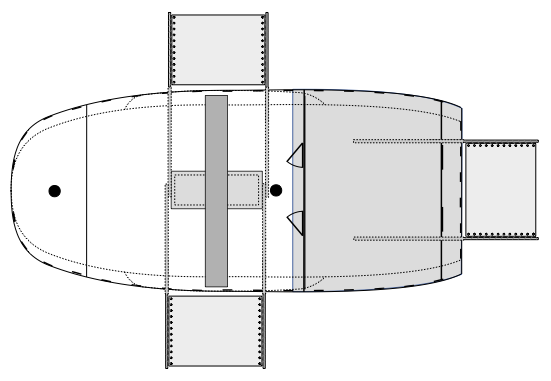
Referring to the illustration, the black dot near its center is the mainmast, which can be used for pole-dancing. Directly aft of it is the companionway ladder which leads from the pilothouse and deck (where there is a completely separate keg party going on) down to the cabin. Directly aft of the companionway ladder are the two aft cabins. Between them is the engine well which is well insulated against sound; aft of the engine well, against the transom, is the propane locker holding two 20 lb tanks of propane used for the galley range, and the water heater when shore power is unavailable. Forward of the engine well and between the aft cabins and the rest of the interior are very substantial, soundproof partitions. This takes care of the people who want to sleep, and the other people who want to have sex at the same time; they won't hear each others' snores and moans, or the noise made by the revelers, nor will the revelers have to listen to them.

Directly to starboard of the companionway ladder is the galley, equipped with a sink, a three-burner propane range with a stove (most likely a Camp Chef) outfitted with a fume hood that exhausts outside (I am amazed that most boat designers neglect this key feature!) a refrigerator (most likely a Dometic 3-way) and some lockers and shelves.

Directly to port is the heads, equipped with a sink, a marine toilet and a shower/sauna. Aft of the shower/sauna compartment is a compartment that holds the water heater, the holding tank and various other bits of equipment.

Forward of the mainmast is the main salon. There are two settees, one on each side, with a drop-leaf table between them. This takes care of the people who want to sit down and eat. With one leaf of the drop-leaf table extended, they can sit on that side of it and eat, while people can still get past them on the other.

In the back of each settee is a pilot berth, which is quite generous. The pilot berths take care of the children who need to be put to bed at some point. There are curtains in front of the pilot berths, which are drawn to give them some privacy.

In the bow is a small sitting room, with room enough for 4-6 people. That takes care of the people who need a quiet corner to chat, work on a laptop or watch a movie.

That rounds out the experience. In all, QUIDNON can be used to host an impromptu gathering of 20-30 souls, and they won't particularly interfere with each other unless they all want to do the same thing at the same time (but this is unlikely). If the weather isn't bad, lots more people can hang out on deck, which is flat and can be set up with deck chairs and an awning.

Oh, and it bears mentioning that all of these activities are quite possible with the boat under way. There is just one spot that's reserved for sail handling, steering and navigation, and that's the helmsman's seat in the center of the pilothouse, directly behind the console. I will discuss it in a future post.

The dark grey areas along the sides are various kinds of storage: shelves, lockers, hanging lockers, cabinets and so on. The space under the pilot berths is occupied by the water tanks, but everywhere else the space under the settees and the berths is also used for storage. This adds up to about 500 cubic feet of storage space, most of it close to the waterline. If used to store water (not recommended) it would weigh 30,000 lbs. If used to store a library of books (slightly more reasonable) it would weigh 8,000 lbs. That is, by most standards, plenty of storage space, especially for a boat.

Thursday, January 15, 2015

Fresh water and anchoring

Water tanks; chain locker
Water is what makes life possible, and salt water doesn't work too well for humans. Drinking it is a very bad idea, limited amounts of it can be used in making soup, it's useless for doing laundry because salted clothes never really dry, and although some salty dogs do wash in salt water, most people prefer fresh.

Most sailboats are quite limited in the amount of fresh water they carry, and when they are used as houseboats outside of a marina (where they can be hooked up directly to shore water) this translates into some amount of discomfort for the residents. When living at a mooring or at anchor (the most economical way to live aboard) it is reasonable to pull up to a fuel dock once a month to pick up water; more often than that, and it becomes a repetitive chore.

QUIDNON has plentiful room for tankage in the awkward, otherwise useless space between the centerboard trunks and the hull. It adds up to 184 cubic feet of space, which equates to 1380 gallons (5225 liters) of tankage and 11,600 lbs of water ballast. A typical shower uses 17 gallons of water, and this means that QUIDNON's water tanks will be sufficient to provide 80 showers.

To be useful as ballast, the water tanks have to be kept full. This, it turns out, is quite easy to arrange by using fresh water bladders made of weldable nylon floating inside tanks that are kept full of salt water, and at “boat pressure” (20 psi or so, much lower than house pressure) using a demand pump. The demand pump is turned off when filling a tank, and the bladders are sized to be somewhat larger than the tanks in which they sit, so that they are never under any pressure. This will make the bladders last a very long time, but spares would of course be carried, so that a new bladder can be swapped in if a tank starts to taste brackish. The tube that taps into a bladder will come out the top, to bleed off the gas that results when the tanks are filled with chlorinated water.

A secondary, fresh water pump would need to be provided for when the boat is drying out during low tide and salt water is temporarily unavailable. The switch-over between the two pumps can happen automatically using a float switch. This will help eliminate the spectacle of annoyed naked people covered in suds running from the shower to the switch panel and back when the tide goes out (and, of course, forgetting to flip the switches back when the tide comes back in and then wondering why the boat is listing to one side).

In addition to the water tanks, another source of “free” ballast comes in the form of anchor chain. A boat of QUIDNON's size requires 7/16-inch chain, about 300 feet of it, which weighs 675 lbs. Well, it's not exactly free; the cost is $2,250 last I checked; but it is otherwise necessary. Nylon rode is quite a lot cheaper, but far less reliable, and for a houseboat that spends most of its time anchored all-chain anchor rode is recommended.

Many sailboat designers find it fun to put a quarter of a ton of chain right at the bow of the boat—the part that's supposed to be especially buoyant. And then they wonder why their designs pitchpole, broach and snap off their masts. By doing so, they create a number of problems. First, obviously, is the weight issue all the way forward: adding weight there increases the angular moment of the boat, causing it to build up angular momentum when bounding up and down waves. Secondly, it is rather difficult for a single-handler to both steer the boat and work the anchor winch in a crowded anchorage, running back and forth between the bow and the helm. Third, while this arrangement makes it possible (if not easy for a single-handler) to anchor from the bow, it makes it almost impossible to anchor from the stern, which is what you want to do when you are heading toward a beach and want to leave open the possibility of getting off that beach again unassisted. This is known as “throwing out a kedge”: the anchor is let go from the transom. Question is, how do you winch in the kedge if the anchor winch is all the way at the bow?

And so, on QUIDNON, what I want to do is locate the chain locker closer to the stern than the bow, so that the anchor winch can be placed right next to all the other lines and controls. There will be two anchor rollers at the bow, tipped down so that the anchors will fall as soon as the anchor chain is given some slack. The anchor chain will drag clear across the deck, through a secondary roller in an aperture at the front of the pilot house, and down into the chain locker below. The reason the anchor rollers are spaced far apart is that QUIDNON will ride much more quietly to anchor when anchored at an angle, so that it presents a V to the waves, cutting through them, instead of slapping into each one with its blunt bow. Anchoring at an angle will also cut down on the noise and put less wear on the mainsail if it is used as a riding sail while at anchor, because then, sheeted in tight, it will always be drawing to one side instead of slatting back and forth.

What all of this adds up to is 15,000 lbs of “free” (or, rather, multipurpose) ballast, enough fresh water for 100 showers, and easy anchoring off the bow or the stern for the single-hander.